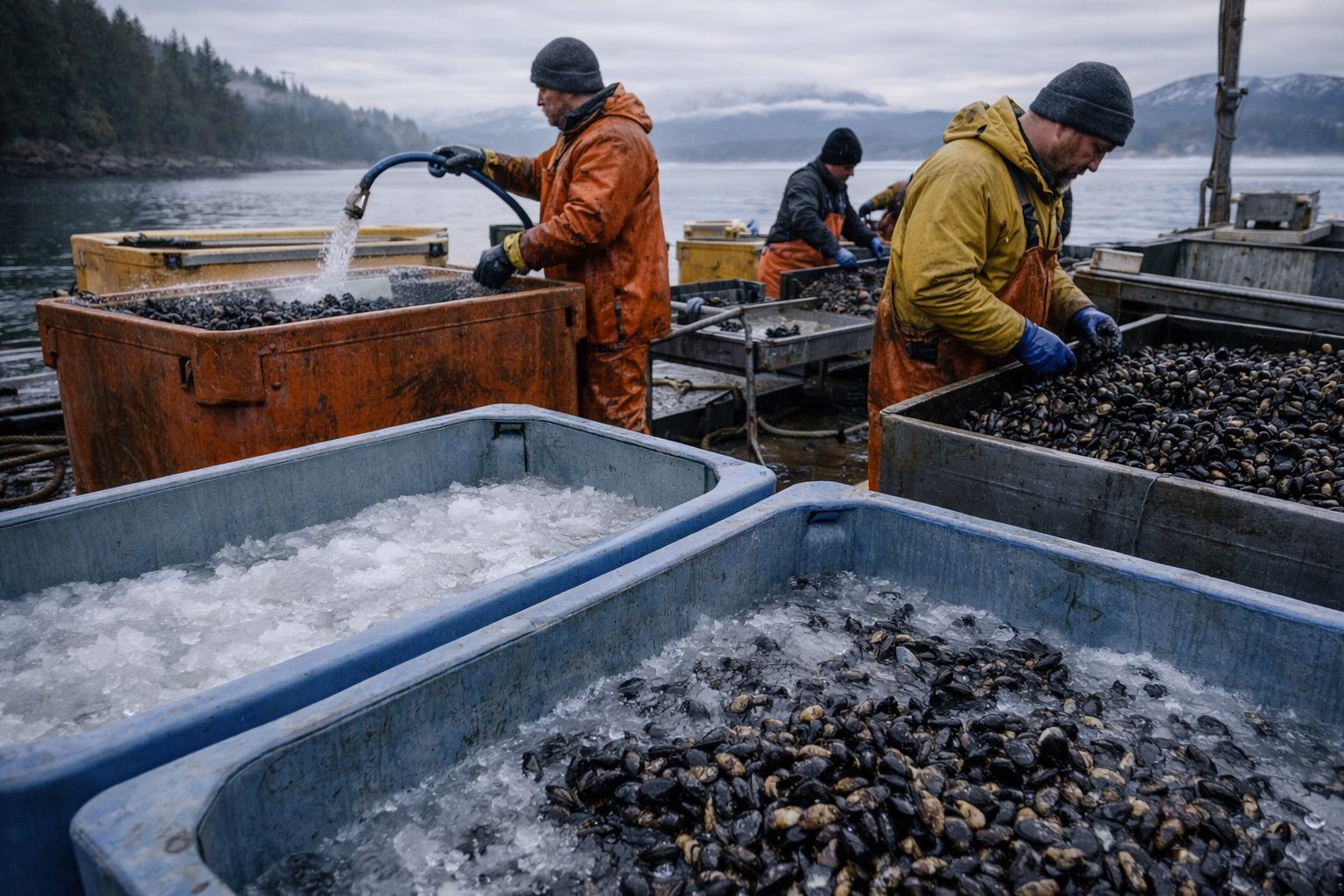
At 3 a.m., while most of Seattle is still asleep, refrigerated trucks roll out toward markets, restaurants, and the airport carrying shellfish that, in many cases, were still in the water the day before. That early-morning departure time is a tell: this is an industry built around clocks, tides, and cold. At Penn Cove on Washington’s Whidbey Island, the mussel business runs on that rhythm harvesting Sunday through Thursday, every week of the year, with a crew of eight to ten working off a barge named Moule Mariner.
If you’ve eaten a bowl of steamed mussels and thought, how hard could it be?, the answer is: harder than it looks, and more human than most supply-chain stories admit. Mussels may be “simple” on the plate, but they’re complex in the way they are grown on ropes, handled on moving decks, washed and graded at sea, then hustled into a packing facility and onto refrigerated routes. Along the way, the people who make it happen: deck crews, plant teams, drivers, supervisors are also managing one of the tougher safety environments in food production. The U.S. Bureau of Labor Statistics puts Seafood product preparation and packaging (NAICS 3117) at 5.7 total recordable cases per 100 full-time workers (2023), more than double the private-industry average of 2.4.
So when Pacific Seafood, owner of the Penn Cove Shellfish brand, talks in its Corporate Social Responsibility reporting about safety dashboards, gap analyses, and expanded training, it’s not corporate garnish. It’s an operating requirement.
The Farm Is a Floating Factory Powered by Timing
Penn Cove’s mussels are grown on rafts that look almost modest from shore until you learn what they hold. Each raft can support about 900 to 2,500 mussel lines, with yields described as up to 50 pounds per line, and about 12 months to reach harvest size. That timeline creates a constant rotation: juveniles coming up, mature lines coming out, production designed for continuity rather than a single annual “season.”
The scale depends on which first-party you ask. Penn Cove Shellfish’s own site says it grows and harvests ~2 million pounds of mussels per year. Pacific Seafood’s brand page describes approximately three million pounds per year from two Washington mussel farms (Penn Cove and Quilcene Bay). Either way, you’re looking at a protein stream that’s measured in millions of pounds and handled by people whose workday is dictated by weather windows and a product that doesn’t forgive delays.
A Day on the Barge: Crews, Repetition, and “Freshness” As Labor
Penn Cove’s harvesting description is unusually candid about mechanics: orders are taken at an office, radioed to the crew, and “that is precisely what will be harvested that day.” Mussels are mechanically washed, graded, weighed, and bagged on the barge, then offloaded to refrigerated trucks at day’s end.
From a labor perspective, that sequence matters. It’s repetitive motion on a moving platform. It’s wet decks. It’s equipment pinch points. It’s heavy totes. And it’s also a kind of craftsmanship that doesn’t read as “craft” unless you’re paying attention: the ability to move fast without bruising shellfish, to keep the deck line flowing without contaminating product, to make the call when something doesn’t look right.
Penn Cove also describes a “super-cooling” step: once packed, mussels are placed into insulated totes, iced, then flooded with seawater to create an ice slurry before being taken to shore and packed at a HACCP-certified packing facility. It’s a small technical detail that reveals a lot: cold chain isn’t just a set of warehouse thermometers, it’s a series of decisions made by people handling products in real time.
The Plant Teams: Where Safety Culture Becomes Visible (Or It Doesn’t)
Processing and packing is where food safety and worker safety collide. The same environment that demands strict hygiene also demands protection from chemical hazards, machinery, and slips and falls. Pacific Seafood’s 2024 CSR report lists recurring safety training topics like chemical hazards, machine guarding/pinch points, confined spaces, PPE, emergency procedures, slip/trip/fall hazards, and near-miss reporting.
What’s notable is the company’s emphasis on systems rather than slogans. In 2024, Pacific Seafood said it launched a dashboard that allows leadership and EHS personnel to monitor injury reporting as it occurs, with the explicit intent of targeting additional training and preventive measures based on trends. It also describes an EHS “gap analysis tracker” used for site-specific feedback and root-cause focus.
Those choices map to what safety researchers often call a “learning” approach: treat incidents and near misses as data, then modify conditions and behaviors. In an industry where the BLS recordable injury rate is high, the difference between “we care about safety” and “we built a feedback loop” is not semantics.
Training As Retention Strategy, Not Just Compliance
One reason seafood plants struggle is that the work is hard to staff and harder to keep staffed. Pacific Seafood positions training as a retention and promotion engine especially for frontline and new managers. In its CSR report, the company says it logged 10,102 hours of training in 2024. It also describes a mobile-accessible learning platform (“Pacific Seafood University”) with over 1,000 self-service training courses, plus performance reviews and annual goals integrated into the system.
The report highlights programs aimed at different career stages: “Team Blue” for frontline development (described as nearly tripling in 2024), and a “Diamond Week” program for newly promoted or hired managers within the prior 15 months, including trips to processing and distribution sites and direct interaction with senior leadership.
There’s also a tuition-grant program in partnership with the University of Arizona Global Campus and George Fox University; Pacific Seafood reports 18 team members enrolled since 2022. For a labor-tight sector, those numbers are not just “good deeds”; they’re an attempt to build a pipeline of supervisors and specialists who understand both the culture and the hazards.
The “Seasonal” Rhythm Without the Seasonal Shutdown
Mussels are often marketed as the low-input, feed-free protein (which they largely are), but the labor reality isn’t a gentle pastoral scene. Penn Cove describes production as “every day… five days a week,” and harvest as Sunday through Thursday “every week of the year.” That steadiness is both a gift and a grind: it can stabilize employment compared with truly seasonal fisheries, but it also means fewer natural pauses for recovery, retraining, or maintenance unless management plans them.
This is where the “people behind mussels” story becomes more than profiles. It becomes scheduling. It becomes cross-training. It becomes whether a plant can rotate jobs to reduce ergonomic injuries. It becomes whether supervisors are trained to treat a near miss as a moment to slow down and redesign a step not as a reason to blame a person.
Pacific Seafood explicitly says it expanded and improved biweekly training with EHS personnel and made chemical audits mandatory for all sites. Those are the kinds of behind-the-scenes controls that tend to determine whether “year-round” is sustainable for workers, not just for supply.
The Last Mile: Why 24 Hours Is a Human Achievement
Penn Cove’s distribution claim is bold: most customers receive product within 24 hours of it coming out of the water. It’s a freshness promise but also a coordination story. Harvest scheduling, grading speed, icing technique, packing capacity, route timing, and driver reliability all have to align. And because shellfish is a regulated food with real safety stakes, the timeline can’t come at the cost of verification and temperature control.
That’s why the mundane line “trucks leave at 3:00 each morning” matters. Someone’s alarm is going off at 1:30. Someone else is cleaning down the line at midnight. Someone is checking tote temps, paperwork, and labels. In a marketing era obsessed with traceability tech, the truth is that cold-chain integrity is still built by people doing unglamorous tasks exceptionally well.
Community Ties Are Part of the Workforce Story, Too
It’s easy to treat seafood labor as anonymous, interchangeable hands. But Penn Cove is also a place, Coupeville is a small town, and “employer of choice” rhetoric gets tested quickly in communities like that. Pacific Seafood’s CSR report notes Penn Cove’s participation in local safety-related events (including assisting authorities in a “man overboard” response) and community fundraising tied directly to mussels: a festival co-hosted with Penn Cove Shellfish raised $10,000 for a high school science scholarship program and $10,000 for the local Boys and Girls Club.
Those details don’t prove a perfect system, but they do underline something important: in many coastal towns, the workforce and the community are the same people. Training investments, safety practices, and scheduling decisions ripple outward.
What I’d Still Want to Know
As an independent journalist, I’m left with a few practical questions that would turn this from “strong narrative” into “hard accountability”:
- Pacific Seafood says injuries have dropped since 2021 and it remains below the industry average, but it doesn’t publish the precise rate in the excerpted CSR section; publishing TRIR/DART over time by division would let readers evaluate progress against the BLS industry benchmark more clearly.
- For a year-round operation, what job-rotation and ergonomic redesigns (beyond “pre-work stretching”) have the strongest measured impact?
- How do depuration/biotoxin-related operational pauses (when they occur) affect crew scheduling and overtime and what safeguards prevent “make-up speed” injuries afterward?
Those aren’t gotcha questions. They’re the next layer of the “people behind mussels” story: the metrics that show whether a system is improving, not just busy.
The Quiet Truth Behind “Easy” Food
Mussels are often praised because they don’t need feed, land, or freshwater the way other proteins do. But the sustainability conversation can skip over a simpler truth: the cleanest protein in the world still needs a safe workplace to be a good story.
On Whidbey Island, the day starts early, the deck is wet, and the work is relentless. The mussels move from rope to barge to HACCP packing facility to a 3 a.m. truck often within a single day. The people behind that chain aren’t background characters; they’re the primary infrastructure. And in a sector where injury rates are statistically high, the most meaningful “innovation” may be the least visible: training hours logged, near misses reported, dashboards updated, and supervisors who know that quality and safety are the same thing, in different uniforms.